
How to read and compare slot bonus rounds before you play
Slot bonus rounds are a major reason many players choose a game, but not all bonuses are equally valuable or entertaining. This guide explains common bonus mechanics (free spins, pick‑and‑click, multipliers, respins, bonus buys, cascading reels and mini‑games), summarizes the core slot concepts that shape a bonus’s practical worth, and outlines how a player can estimate whether a bonus fits their bankroll and preferences.
Common bonus mechanics and what they mean for value and fun
Understanding the mechanics behind a bonus round helps set realistic expectations. Below are frequent types of bonus features and what they usually offer in terms of excitement and potential payout.
Free spins
Free spins award a number of automatic spins, often with enhanced features such as stacked wilds, extra multipliers or retriggers. Free spins can be high in entertainment and can boost practical value if the underlying free-spin mode includes meaningful multipliers or higher hit frequency.
Pick‑and‑click (bonus pick)
Pick‑and‑click mini‑games let the player choose items to reveal prizes. These are engaging and provide clear immediate wins, but prize sizes tend to be modest compared with volatile multiplier modes.
Multipliers and respins
Multipliers increase payouts for individual wins; respins give additional single-spin opportunities after a win or special symbol. Both can dramatically change short‑term payout potential, especially when combined with high volatility.
Bonus buys
Bonus buys let a player pay to trigger the bonus instantly. They remove variance and are useful for players wanting immediate access to the feature, but cost should be compared against expected return and personal bankroll limits.
Cascading reels and mini‑games
Cascading reels (symbols fall away and new ones drop in) can create chain wins and are often more entertaining. Mini‑games embedded in bonuses add variety but vary widely in expected value depending on rules and multipliers.
Which game features most affect the practical value and bankroll fit
Several measurable and observable metrics determine how a bonus behaves in practice. Knowing them helps a player compare options objectively.
- RTP (Return to Player): A theoretical long‑term percentage of wagers returned to players. RTP is not a prediction for any single session but gives a baseline for comparing games when reliably available.
- Volatility (variance): High volatility means larger but less frequent wins; low volatility gives smaller, steadier payouts. Bonuses in high‑volatility slots can produce big wins but require a larger bankroll or patience.
- Hit frequency: How often a win or bonus occurs. Higher hit frequency reduces short‑term bankroll swings but may lower top‑end potential.
- Paylines / winning mechanics: More ways to win or cluster pays often increase the chance of small wins during bonus modes.
- Bet range and max win: Minimum/maximum bet options determine who the feature suits; advertised max win caps upside.
- Wagering requirements: If a bonus is tied to a casino promotion, wagering (playthrough) requirements reduce the cashable value — always read terms carefully.
- Demo testing availability: Playing in demo mode is the safest way to observe hit frequency, feature length and perceived fun before staking real money.
To estimate practical value, compare the bonus’s visible mechanics (e.g., multipliers, retriggers) with the game’s volatility and test several demo sessions to observe typical bonus behaviour. Also factor in wagering requirements or cost of bonus buys — both directly reduce the real value a player can expect to extract. The next section will walk through a step‑by‑step evaluation process to score a specific game’s bonus round and compare several titles side‑by‑side.
Step‑by‑step bonus evaluation checklist
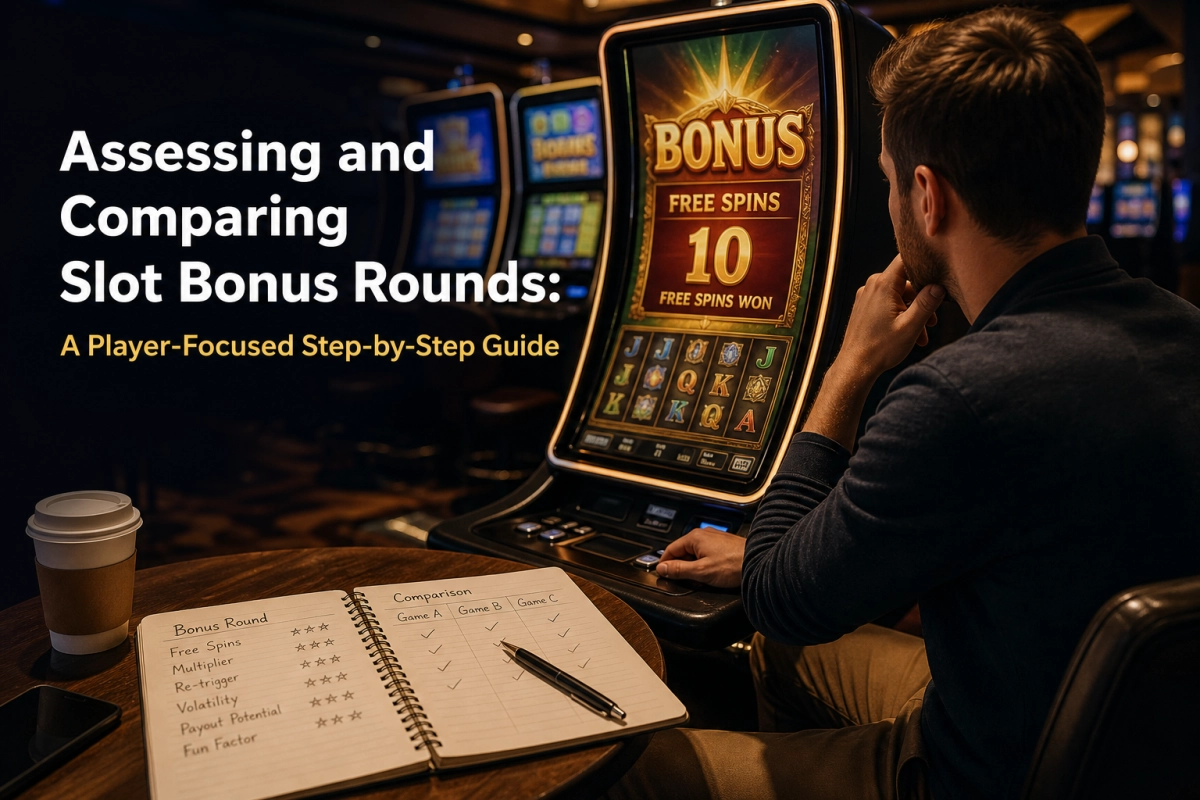
Use this checklist whenever you want to score a bonus round objectively. Work through each step in order and give a simple score (e.g., 1–5) for how well the game performs in that area — you’ll end up with a quick, comparable summary you can use across titles.
1. Gather the hard facts
– Note RTP, stated volatility (if available), max win (as × bet) and bet range. Record whether a bonus buy exists and its cost in × bet.
– Read the bonus rules: retrigger conditions, multiplier caps, and any special restrictions.
2. Observe the feature mechanics
– Identify the bonus type (free spins, pick, respin chain, cascading, mini‑game) and list the in‑mode modifiers (multipliers, stacked/wild behaviors, respins).
– Score entertainment potential based on variety, interactivity and visual pacing.
3. Demo sample and measure
– Play demo mode (or low‑stake runs) until you’ve hit the bonus multiple times (see next section for sample sizes). Note average bonus length (spins/choices), average in‑bonus wins (expressed as × your base bet), and frequency of retriggers.
4. Quick EV check for bonus buys
– Compare average observed win (× bet) against buy cost (× bet). If buy cost > average win by a large margin, the buy is negative EV — buy only if you accept it as entertainment and can afford the cost.
5. Check wagering and promotion terms
– If the bonus comes via a promotion or free spins from a casino, check wagering multipliers, max cashout and bet limits. Reduce your score for heavy playthroughs or low cashout caps.
6. Final practical score and notes
– Combine: RTP/volatility fit (bankroll suitability), average bonus payout (× bet), entertainment score and wagering penalties. Use a simple weighted score (for example: 30% payout, 30% volatility/bankroll fit, 30% entertainment, 10% wagering) to rank games side‑by‑side.
Record brief notes (e.g., “good retriggers, low average win, bonus buy overpriced”) so comparisons are quick next time you review multiple games.
Demo testing, wagering rules, bankroll fit and responsible‑play tips
Demo testing and clear reading of terms are the most practical steps to avoid surprises. Follow these guidelines to make tests meaningful and to keep play responsible.
– How much demo testing is useful
– Aim for at least 200–500 base spins to understand hit frequency and 30–100 bonus triggers to sample bonus payouts. Smaller samples can mislead, but these ranges usually reveal consistent patterns.
– Track results in a simple spreadsheet: number of spins, number of bonuses, average bonus payout in × bet and notable outliers.
– Interpreting wagering requirements and promo fine print
– Identify what amount is subject to wagering (winnings only, deposit + winnings, etc.), the required multiplier (e.g., 30×) and any max cashout limits or bet caps during playthrough.
– Treat heavy wagering requirements as a discount on the nominal bonus value — the higher the multiplier, the less practical cash you’ll likely extract.
– Matching a bonus to your bankroll
– For low‑volatility features, a 20–50× average bet bankroll often suffices; for high volatility or features with expensive buys, consider 100–200× or more depending on how long you want to sustain losing streaks.
– Never size stakes so large that a single bonus buy or a handful of rounds meaningfully harms your essential funds.
– Responsible‑play rules of thumb
– Set strict session and loss limits before you play and stick to them. Use demo mode to avoid impulsive buys.
– Treat bonus buys as paid entertainment, not investment. If a buy is negative EV, only purchase it within a preallocated entertainment budget.
– Take breaks, avoid chasing retriggers, and use casino tools (limits, timeouts, self‑exclusion) if you feel control slipping.
Using these practical steps — measured demo testing, simple EV checks for buys, careful reading of wagering terms and sensible bankroll rules — lets you compare bonuses in a way that balances potential returns with fun and responsible play.
Iterate and refine your comparisons
Keep a lightweight log of games you test and the scores from your checklist. After a few sessions you’ll notice which scoring weights reflect your priorities (payout potential vs. entertainment, for example) and can adjust them. Periodically revisit older notes — developer updates or new volatility assessments can change a game’s profile over time.
Deciding when to act
Use your objective scorecard to make a binary choice: either a game’s bonus passes your bankroll/entertainment threshold and you play it with pre-set limits, or it fails and you skip it. This reduces impulsive decisions and makes bonus buys and larger stakes deliberate rather than reactionary.
Final notes for responsible, enjoyable play
Approach bonus rounds with the same pragmatic mindset you’d use when choosing any paid entertainment: know what you want (big wins, steady action, or pure fun), set limits, and use your testing data to guide choices rather than impulse. Treat negative‑EV options as occasional paid entertainment if you decide the thrill is worth it, and never stake money you can’t afford to lose. If play stops being fun or starts affecting other areas of life, take a break and use the casino’s responsible‑gaming tools.