
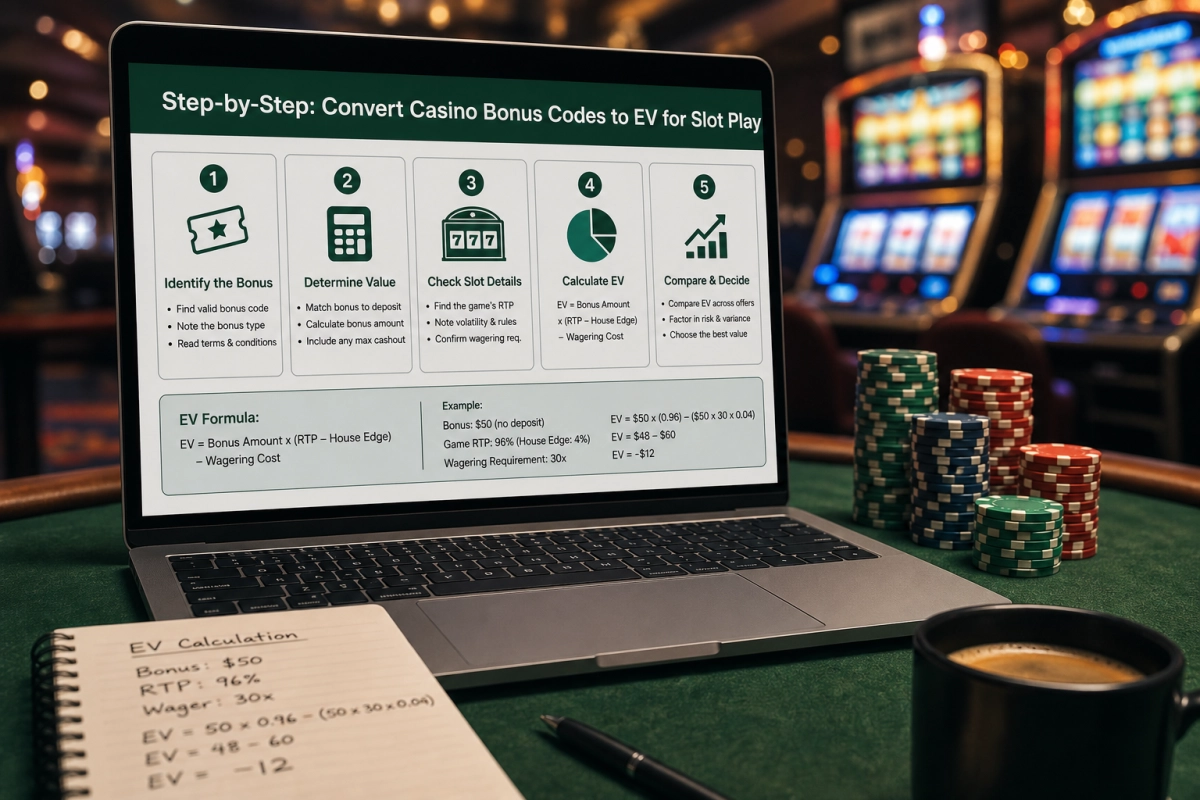
How to turn casino bonus codes slots into a usable expected value (EV)
Casino bonus codes slots are common offers but their headline value (free spins, bonus cash) rarely equals real value without adjusting for game rules and wagering terms. This guide explains the first steps a player should take to convert an individual bonus into a numerical expected value (EV) for slot play. It focuses on the factors that change the math: RTP, volatility, slot contribution rates to wagering requirements, bet and max‑cashout limits, and the mechanics of the slot itself.
Why converting a bonus into EV matters before playing
Understanding EV helps a player compare different offers objectively and decide which to accept. EV is a theoretical average return after all terms are considered. It does not promise short‑term results or guarantee profit; it simply shows whether, on average, the bonus moves the player’s balance in a positive or negative direction when combined with the chosen game.
- Clarifies real value: converts promotional language into money terms.
- Enables comparisons: rank multiple casino bonus codes slots by expected return.
- Supports risk decisions: fit offers to a player’s bankroll and tolerance for variance.
Key slot and bonus terms that change EV
Before any calculation, the player must gather precise terms from the bonus T&Cs and the slot game page. Below are essential definitions and why they matter to EV.
Return to Player (RTP)
RTP is the theoretical long‑term percentage of wagers that a slot returns to players. For example, a 96% RTP suggests that, over many spins, the machine will return about 96% of the money wagered. RTP is theoretical — it does not predict short sessions or guarantee outcomes — but it is the baseline for converting spins or bonus bets into expected monetary return.
Volatility (variance) and hit frequency
Volatility describes payout distribution: high volatility yields infrequent large wins; low volatility gives frequent small wins. Volatility does not change the long‑term RTP, but it affects the short‑term distribution of results and the probability of meeting wagering requirements before going bust. Hit frequency is the chance of any winning spin; it helps model how quickly a bonus will be consumed or generate cashable wins.
Wagering requirements and contribution rates
Wagering requirements (e.g., 30x) define how many times the bonus or deposit must be wagered before withdrawals are allowed. Contribution rates are crucial: many slots contribute 100% to playthrough, while table games or some slot types may contribute less or not at all. A 100% contribution means each bet counts fully toward the requirement; a 10% contribution multiplies required real wagers by 10 for practical EV calculations.
Bet limits and maximum cashout
Casinos often impose maximum bet limits while bonus active and a cap on how much can be cashed out from bonus winnings. Maximum bet limits affect volatility choices (high‑variance play may be impossible), while max‑cashout reduces upside and must be included when estimating expected return.
Slot mechanics that affect model assumptions
Paylines, reels, wilds, scatters, multipliers, free spins and bonus rounds influence both RTP and variance. For example, buy‑bonus or jackpot mechanics often change effective RTP and max win potential; these should be verified on the official game page before using them in an EV model.
With these definitions and the exact bonus terms collected, the next section will show a step‑by‑step calculation method and worked examples that convert a real bonus into a numeric EV and recommend player types for each scenario.
Step‑by‑step method to turn a single slot bonus into EV
Below is a compact, repeatable procedure you can apply to nearly any slot bonus code offer. It uses only values found in the game page and bonus T&Cs and produces a quick numeric EV estimate you can compare across offers.
- Gather values: number of free spins or bonus cash (B), bet size per spin if stated (b), RTP of the chosen slot (R), wagering requirement multiplier (WR, e.g., 30 for 30x), contribution rate (C, as a decimal, e.g., 1.0 for 100%), and maximum cashout cap (Cap, if any).
- Compute total equivalent stake from the promotional play: for free spins, total_equiv_stake = number_of_spins * bet_size. For bonus cash, initial bonus amount is B (you may consider deposit separately if it is part of the offer).
- Estimate expected gross winnings from play using RTP: expected_gross = total_equiv_stake * R (or, for bonus cash when you expect to wager the bonus many times, use the expected return of the wagering sequence as shown in worked examples below).
- Translate wagering requirements into expected additional bets required: required_wagers = WR * (the amount the T&Cs apply to). If contribution is less than 100%, required effective wagering on the eligible game becomes required_wagers / C, increasing the practical cost.
- Calculate expected loss while clearing the wagering: expected_loss = required_wagers * (1 – R), assuming you play the same RTP game for the wagering. This is the house edge cost of the required volume of bets.
- Apply max‑cashout and other caps: if expected_gross > Cap, set expected_gross = Cap (and re‑compute required_wagers if WR applies to capped amount instead of raw wins).
- Net EV estimate = expected_gross − expected_loss. If negative, the bonus is expected to lose money on average after playthrough; if positive, it is expected to add value.
Why the method works (intuition)
The straightforward idea is that the bonus gives you betting volume you would otherwise have had to buy. You get expected return proportional to RTP on that betting volume, but you also must place the wagering volume required by the casino which costs you the house edge on those bets. The two terms — gross expected return from the bonus bets and expected loss from required additional betting — are the components that mostly determine EV.
Worked examples
Example 1 — 50 free spins, $0.20 per spin, 96% RTP, 30x wagering on winnings
- Total equivalent stake = 50 * $0.20 = $10.
- Expected gross wins = $10 * 0.96 = $9.60.
- Wagering requirement applies to winnings: WR = 30, so required_wagers = 30 * $9.60 = $288.
- House edge if you play the same 96% RTP game = 1 – 0.96 = 0.04.
- Expected loss from clearing WR = $288 * 0.04 = $11.52.
- Net EV = $9.60 − $11.52 = −$1.92. In this simple model the free spins are worth about −$1.92 on average (i.e., a small expected loss).
Example 2 — $50 bonus cash, 20x wagering on bonus, play on 96% RTP slot
- Bonus amount B = $50. WR = 20, required_wagers = 20 * $50 = $1,000.
- Expected loss clearing WR = $1,000 * 0.04 = $40.
- Straight net EV = bonus_amount − expected_loss = $50 − $40 = $10.
- This simplified approach assumes the WR applies to the bonus only and that you can follow the same RTP game. Under these assumptions the $50 bonus has positive EV of about $10.
Note: these examples are intentionally simplified. Real offers often attach additional constraints (contribution <100%, max bet caps, caps on win amounts, or WR that applies to deposit+bonus) which should be inserted into the same computation steps above.
When to use analytic formulas vs. simulation
The quick analytic formula explained here gives a fast, practical EV estimate that is correct on average under the assumption of linearity and consistent RTP across all required bets. It does not capture the probability of going bust before meeting WR, the effect of max‑cashout interacting with high‑variance spins, or the distribution tail of occasional large wins.
Use Monte Carlo simulation when:
- You need the probability distribution of outcomes (chance to finish positive, chance to reach max cashout).
- Variance and hit frequency strongly affect whether you can clear WR before running out of bankroll.
- The max win or bonus buy features create a non‑linear payoff that truncates outcomes.
For most routine comparisons, the analytic method is adequate and much faster. For large bonuses, jackpot mechanics, or when building a professional advantage play, run simulations that model spins, balance, bet sizing and stopping rules.
Practical tips to maximize realized EV
- Choose high‑RTP slots to minimize the house edge used in clearing wagers.
- If you have a thin bankroll relative to required wagers, pick lower‑variance games so you are less likely to bust before completing WR.
- Check contribution tables: a 100% contribution slot is far better for bonus EV than a 10% contributor.
- Watch the max‑cashout. If the cap is low relative to expected gross, the offer may be worthless even if raw math looks good.
- Keep bet sizes near the minimum allowed while clearing WR to prolong play and give variance time to work in your favor (as long as the T&Cs don’t force minimums per spin for playthrough).
- Record your play and re‑estimate EV after a sample of spins — RTP is theoretical, but over time outcomes converge toward the expected values used in this model.
Common pitfalls and final checklist
- Misreading the WR base (bonus only vs. deposit+bonus).
- Forgetting contribution rates or treating them as 100% by default.
- Ignoring bet and max‑cashout limits that can nullify the theoretical upside.
- Using short‑session outcomes to judge long‑term EV — variance can deceive.
Before accepting any offer, run through this checklist: confirm RTP, volatility, contribution, WR base, bet cap, and max cashout. Apply the step‑by‑step math above. If the resulting EV is positive and you are comfortable with the bankroll and volatility implications, the bonus is worth considering. If it is negative, or if extreme variance or caps make the analytic number unreliable, skip it or simulate before committing real funds.