
Why the random number generator (RNG) matters for every spin you make
When you press “spin,” what you see—the reels stopping, the symbols lining up—starts with a stream of numbers inside the machine. The RNG is the piece of software (or hardware) that produces those numbers. You don’t interact with the RNG directly, but its behavior determines whether you get a tiny win, a big jackpot, or nothing at all. Understanding the basics helps you separate myths from facts about fairness and control.
What “random” really means in modern slots
Most commercial slot machines use a pseudorandom number generator (PRNG), an algorithm that produces a long sequence of numbers that appear random. A PRNG starts from an initial value called a seed and then applies deterministic calculations to create the sequence. Because the sequence is deterministic, the same seed produces the same series of numbers—but the seed is kept private and changes often, so you can’t predict outcomes.
How a random number becomes the symbols you see
The mapping from raw numbers to reel symbols is a two-step process that you should know if you care about odds and volatility:
- Generate a number: The RNG continuously churns out numbers (often many per millisecond). When you press spin, the game samples the current RNG value.
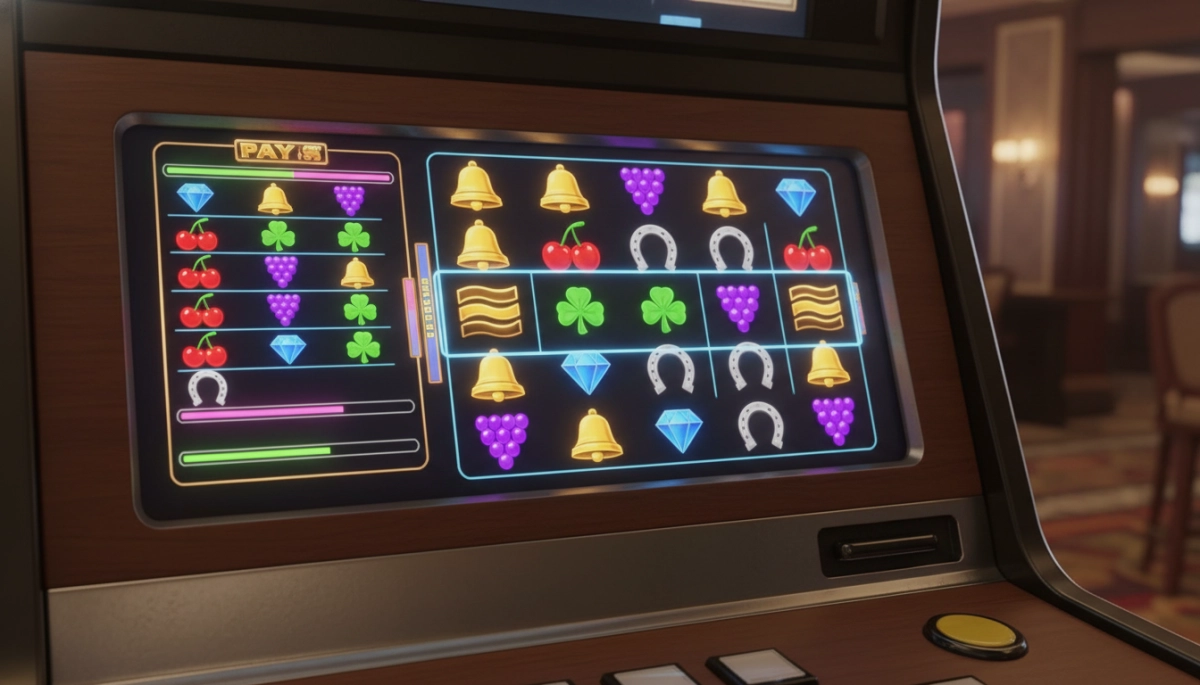
- Map to reels and paytable: That sampled number is converted into positions on virtual reels. Each position corresponds to a symbol; the paytable defines which combinations pay what. Game designers weight symbols by assigning multiple virtual positions to common symbols and fewer positions to high-value ones.
This means that an apparent “near-miss” is just the consequence of how positions are distributed on virtual reels, not evidence of manipulation. Also note that spins are independent: the RNG does not “remember” past outcomes to force wins or losses on a schedule.
What influences hit frequency and volatility
Two terms you’ll see frequently are hit frequency (how often you get any payout) and volatility (how big and how rare payouts are). These are set by:
- Symbol weighting on virtual reels (more common vs. rare positions).
- The paytable (how much each winning combination pays).
- The algorithm’s mapping rules and the sample moments from the RNG.
Designers tune these factors to achieve a target return-to-player (RTP) percentage over the long run. For you as a player, that RTP is a statistical expectation, not a guarantee for short sessions.
How regulators and labs make sure the math is honest
Independent testing labs and regulatory bodies validate that the RNG behaves as claimed. They perform statistical tests on long output streams, verify source-code implementations, and check that RTP and volatility match published figures. Typical checks include frequency distribution tests, entropy measurements, and simulation of millions of spins.
In the next section you’ll learn how seeds are chosen, how they affect predictability, and how odds and RTP are calculated from the underlying RNG model.
How seeds are chosen — and why you can’t realistically predict spins
The seed is the starting point for a PRNG’s sequence, so in theory if you knew the exact seed and algorithm you could reproduce future outputs. In practice, slot manufacturers and operators take multiple steps to make that impossible.
Sources of seed entropy vary by platform. On land-based machines the seed might be derived from a mixture of system clock values, hardware entropy sources (like thermal noise), and other unpredictable inputs. Online casinos typically use stronger approaches: cryptographically secure PRNGs (CSPRNGs) seeded from high-entropy pools that pull from operating-system randomness, dedicated hardware RNG modules, or specialized entropy services. These sources make the initial state extremely hard to guess.
Developers also reseed frequently. A PRNG will often be reseeded periodically or mix new entropy into its state continuously, so even if you could momentarily infer the seed it would be stale a fraction of a second later. On top of that, seeds and internal states are never exposed externally; they remain private to the game process or the remote server.
There are two practical takeaways:
– Bad seeding is the real weakness. If a game used only a predictable value (like the current millisecond timestamp) as its seed and never reseeded, that could theoretically allow an attacker to predict outcomes. Reputable vendors avoid this.
– Online vs. land-based differences matter. Many online games run their RNG server-side, so the operator controls the entire randomness pipeline; reputable operators use audited, certified RNGs. Client-side implementations must be careful to avoid exposure of seed data.
Regulators and labs test for weak seeding as part of their certification process. They look for low entropy, repeated cycles, or any statistical artifacts that suggest a predictable seed. That’s why, for most players, “predicting” a slot spin remains a theoretical curiosity rather than a practical exploit.
From random numbers to RTP and odds — the math behind each payout
Turning RNG outputs into an advertised return-to-player (RTP) is a straightforward but powerful application of probability.
Every virtual reel is implemented as a list (strip) of symbol positions; a symbol’s probability is simply its occurrences divided by the strip length. For a three-reel machine, the chance of getting a particular three-symbol combination is the product of the probabilities for each reel position (assuming independent sampling per reel). Modern video slots use many virtual stops and bonus mechanics, but the same principle applies: compute the probability for each possible outcome, multiply by its payout, and sum across all outcomes to get the expected return.
Formally:
– Payout expectation = Σ (probability of outcome i × payout for outcome i)
– RTP = expectation ÷ bet size (expressed as a percentage)
– House edge = 1 − RTP
Designers adjust virtual reel counts, symbol weightings, and paytable values to hit a target RTP while shaping hit frequency and variance. For example, increasing the number of stop positions for low-value symbols raises hit frequency but lowers average win size; reducing placements for high-value symbols makes big wins rarer and raises volatility.
Special features (free spins, multipliers, progressive jackpots) change the calculation by adding conditional branches — you calculate expected returns for each feature pathway and include their probabilities. Independent labs verify these calculations by running massive simulations and statistical tests against live output to ensure the long-run RTP matches the published figure.
Understanding this math explains why short-term sessions can deviate wildly from RTP: RTP is a long-run expected value built from millions of independent RNG samples, not a promise for any single play session.
Verifying an RNG and a game’s fairness
- Look for independent test-lab seals from organizations such as eCOGRA certification or GLI—these indicate the RNG and RTP claims have been audited.
- Check the operator’s license and published audit reports; reputable sites list game-specific RTPs and testing summaries.
- Prefer games from well-known providers with transparent documentation; unknown or unverified titles are a higher risk.
- If you suspect a problem, contact the regulator named on the operator’s license and request lab-report details.
Practical tips for players
- Treat RTP as a long-term statistic and set session limits to control variance-driven swings.
- Avoid strategies promising to “beat” the RNG—spins are independent and cryptographically protected on reputable platforms.
- If you value transparency, play on platforms that publish independent audit results and have visible licensing information.
Final thoughts on RNG and fair play
RNG technology is the backbone of modern slot fairness. When developers and operators follow best practices—using strong entropy sources, audited algorithms, and transparent reporting—players can rely on probability rather than guesswork. If you combine that trust with sensible bankroll management and by choosing certified games and licensed sites, you put the odds of a fair experience on your side.